
Do Banks Treat OnlyFans Income Differently?
For many creators earning through OnlyFans, one question comes up repeatedly: will banks treat this income differently from a normal job or business?
The answer is sometimes — but not always.
In the UK, income earned through content creation is legal self-employed income, and most banks will recognise this and have no issue. However, some creators do experience problems such as payment reviews, frozen accounts, additional compliance checks, or difficulties applying for financial products. In most cases, this is less about the platform itself and more about how banks assess risk and monitorunusual account activity.
If you read our article from a few weeks ago you’ll know that banks have a responsibility to make sure they act with caution with regard to the legitimacy of the money in their accounts.
Why Banks Review Creator Income
Banks are required to follow strict anti-money laundering and fraud prevention regulations. Whenever large or irregular payments begin entering an account, automated systems may flag the activity for review.
This is not unique to creators. Freelancers, influencers, crypto traders, online businesses, and self-employed workers can all trigger similar checks when their banking activity changes suddenly or appears inconsistent.
However, adult-content related income can sometimes attract additional scrutiny. Some financial institutions classify adult entertainment as a higher-risk industry, particularly when payments involve international transfers or third-party payment processors.
This does not necessarily mean a bank will reject the income, but it can mean additional compliance checks or requests for information.
Can Banks Close Accounts Because of OnlyFans Income?
Some creators worry that banks may close or restrict their accounts because they earn through OnlyFans. While this can happen in certain situations, it is usually linked to risk policies or compliance concerns rather than the platform.
Banks are private businesses and have their own internal policies regarding industries they consider higher risk. If an account suddenly receives large incoming payments, frequent international transfers, or unusual transaction patterns, the bank may decide to review the activity more closely.
In some cases, creators may be asked to provide:
- proof of income
- identification documents
- tax information
- evidence of business activity
If the bank remains uncomfortable with the risk profile, it may choose to restrict or close the account.
The Importance of Separating Business and Personal Finances
One of the most common mistakes creators make is managing everything through a standard personal current account.
When creator income is mixed with everyday spending, subscriptions, shopping, and personal transfers, it can create confusion during compliance reviews. From the bank’s perspective, unclear transaction patterns may make it harder to identify the source and purpose of funds.
Using a separate account for creator income can make finances appear far more professional and transparent. It also makes bookkeeping easier and helps simplify tax returns, expense tracking, and income reporting.
Even creators operating as sole traders can benefit from treating their work like a proper business from the beginning.
Do Mortgage Lenders View OnlyFans Income Differently?
Mortgage applications can sometimes feel more complicated for creators, but lenders are usually more concerned with consistency than the source of income itself.
Most lenders want to see:
- stable earnings
- properly filed tax returns
- organised accounts
- proof of affordability
- a reliable income history
If a creator can demonstrate consistent earnings and accurate tax reporting, many lenders will treat OnlyFans income similarly to other forms of self-employment.
Problems typically arise when income has not been declared to HM Revenue and Customs or when financial records are incomplete. Undeclared earnings and poor bookkeeping can make any self-employed mortgage application more difficult, regardless of the industry involved.
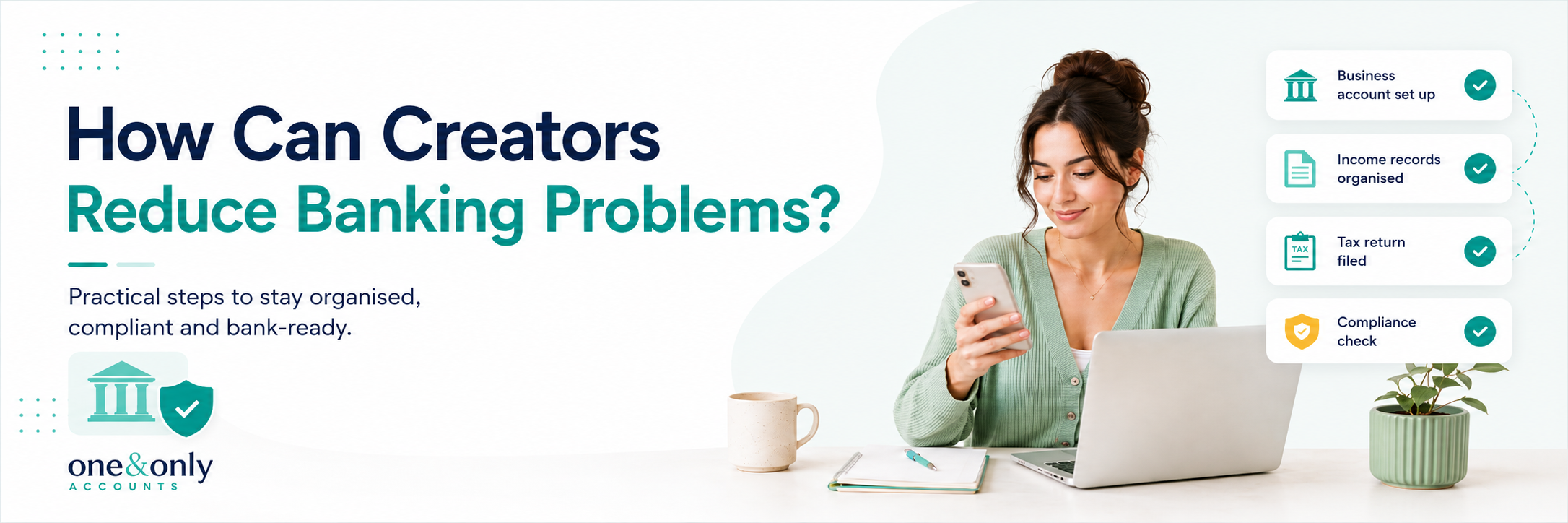
How Can creators Reduce Banking Problems
Creators who manage their finances professionally are generally far less likely to experience issues with banks or lenders.
Keeping accurate records, saving payout statements, tracking business expenses, and filing tax returns correctly all help demonstrate legitimacy and financial stability.
Many creators also choose to work with accountants who understand subscription-platform income and the creator economy. Specialist advice can help ensure taxes are handled correctly while also improving financial organisation for future mortgage or loan applications.
As the creator industry continues to grow, financial institutions are gradually becoming more familiar with digital creator businesses. Banks are increasingly adapting to modern online income streams, particularly when creators present themselves professionally and maintain transparent financial records.
Final Thoughts
OnlyFans income is legal self-employed income, and most banks will not automatically treat it negatively. However, because creator earnings can involve irregular payments, international transactions, and adult-content related activity, some banks may apply additional compliance checks or risk assessments.
In most cases, the creators who experience the fewest problems are those who stay organised, declare their income properly, and treat their work as a genuine business.
As online content creation becomes more mainstream, banking and lending processes are gradually becoming more accommodating to creators who operate professionally and remain fully tax compliant.
Still have questions? We're here to help contact us here for friendly advice tailored to your situation
Disclaimer: Any advice in this publication is not intended or written by One & Only Accounts to be used by a client or entity for the purpose of (i) avoiding penalties that may be imposed on any taxpayer or (ii) promoting, marketing or recommending to another party matters herein.