
HMRC Focus On Digital Income Intensifies - Turning Up The Heat On Content Creators

As the new tax year begins, HMRC is once again intensifying efforts to identify areas where income tax has gone unpaid. One of the most significant opportunities lies within online marketplaces for goods and services—spaces where individuals have, until recently, operated with a degree of anonymity.
That era is over.
Authorities are now turning their attention directly to digital platforms, cracking down on undeclared income earned online. In just this calendar year, details of almost 4 million account holders have reportedly been obtained.
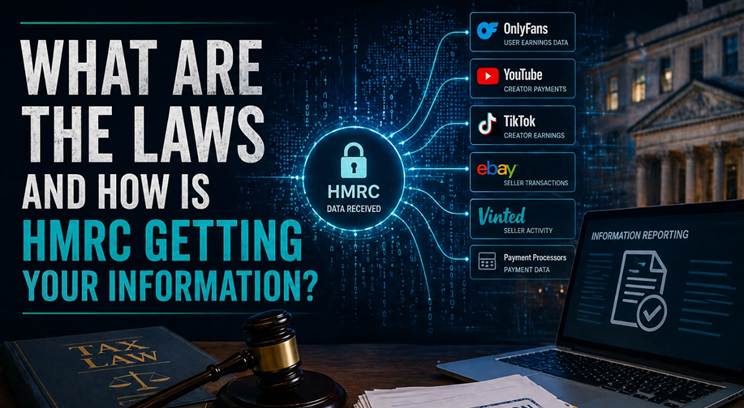
This includes users of content platforms such as OnlyFans, Fansly, ManyVids, YouTube, and TikTok, as well as individuals selling goods via platforms like Vinted, eBay, and similar marketplaces.
In this article, we explore the new laws introduced to target online income streams, identify who may be at risk, outline the potential penalties for non-compliance, and explain the steps you can take to bring your tax affairs up to date.
What are the laws and how is HMRC getting your information?
In 2012, HM Revenue & Customs (HMRC) helped usher in a new era of digital information sharing by adopting the Automatic Exchange of Information (AEoI). This framework enabled tax authorities across jurisdictions to share financial data relating to both declared and undeclared income.
At the time, the legislation was primarily aimed at tackling tax evasion by non-resident individuals who failed to declare income in the country where tax was due.
Nearly 15 years on however, the Organisation for Economic Co-operation and Development (OECD) has expanded these requirements further. Under its Digital Platform Reporting rules, the obligation now extends to online platforms themselves, which must collect and report information about the income earned by their users—marking a significant shift in how digital earnings are monitored and enforced.
With these laws introduced as of 1st January 2024, information will be shared in batches with the number of account holders whose information has been passed on in 2026 reaching almost 4 million already.
With HMRC placing a strong focus on the use of these powers it may well become a question of when rather than if those with undeclared income find themselves under investigation.
What are the punishments for undeclared income?
Tax specialists suggest that the new legislation marks an unprecedented shift in the ability of authorities to detect non-compliance. Dawn Register, a tax dispute resolution partner at BDO, has described the scale of available data as a “goldmine” for tax inspectors.
So, what happens if you’re caught with undeclared income and unpaid tax?
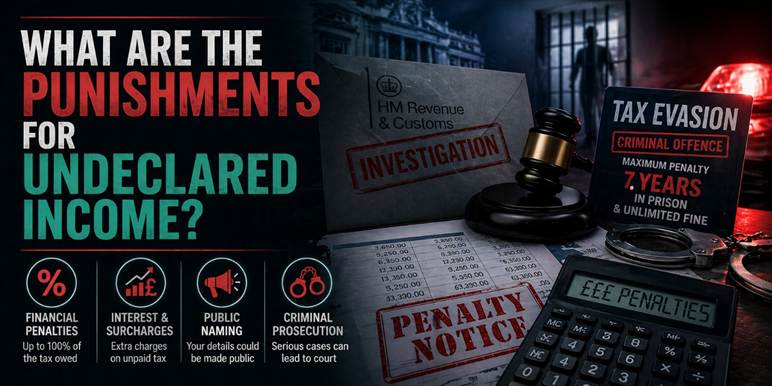
In short, the consequences can be severe - ranging from financial penalties to, in the most serious cases, criminal prosecution and imprisonment. But the process typically unfolds in stages.
HM Revenue & Customs (HMRC) will usually begin by identifying discrepancies in reported income and opening an enquiry. In standard cases, they will review a four-year period, focusing on errors that may have arisen through carelessness. However, where there is suspicion of deliberate behaviour, this window can extend to six years—or up to twenty years in cases involving deliberate concealment.
Penalties are applied based on the nature of the non-compliance. Careless errors can result in fines of up to 30% of the unpaid tax. The exact penalty depends on several factors, including the amount owed and the behaviour involved but fines can rise to 100%.
In addition to penalties, interest accrues on any unpaid tax from the original due date. Late payment can trigger further surcharges, meaning liabilities can escalate quickly if left unresolved.
At the most severe end of the spectrum, cases may proceed to criminal prosecution. Tax evasion offences can carry prison sentences of up to seven years, as well as unlimited fines, depending on the gravity of the offence.

What do you need to do to keep yourself up to date?
Tax can be complex at the best of times - particularly for those working in evolving digital industries, managing multiple income streams, or operating across different platforms.
No two situations are the same, and ensuring compliance often requires a tailored approach built on a clear understanding of your individual circumstances. For that reason, seeking professional advice before filing is strongly recommended.
Working with experienced specialists who understand the nuances of your income and industry allows you to move forward with confidence - knowing your affairs are in order and fully compliant with HM Revenue & Customs requirements. It also removes the uncertainty and stress of potential enquiries, so you’re not left worrying about unexpected letters or investigations down the line.
If you’re unsure as to how to move forward, the time to act is now, contact us for more information about what to do next