Tax Avoidance vs Tax Evasion - What's the Difference?
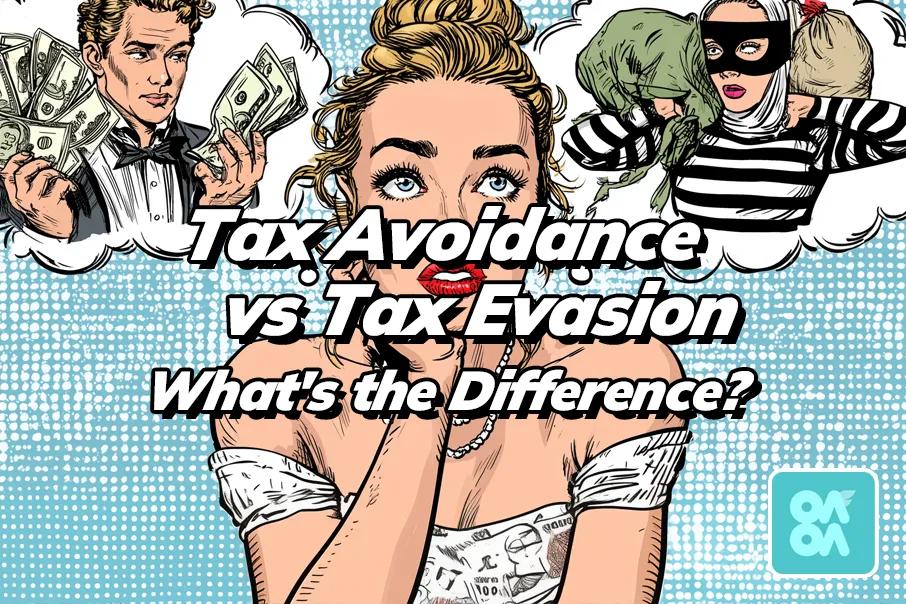
Paying tax is a fact of life for individuals and businesses.
However, not everyone approaches their tax obligations in the same way.
Some engage in tax avoidance while others resort to tax evasion.
But what is the difference between tax avoidance vs tax evasion?
Understanding the difference between these two is crucial for UK individuals and small business owners to stay on the right side of the law and avoid hefty penalties.
Key Takeaways
- Tax avoidance involves arranging your finances within the law to minimise tax, whereas tax evasion means breaking the law by concealing income or information. The former is legal, the latter is a criminal offence.
- Common tax avoidance measures (legal) include using tax-free accounts like ISAs, contributing to pensions for tax relief, or claiming valid business expenses. These are acceptable ways to reduce your tax bill within the rules.
- Common tax evasion tactics (illegal) include not declaring all your cash income, hiding money in undeclared offshore accounts, or falsely claiming personal expenses as business costs. These actions mislead HMRC and violate tax laws.
- Tax evasion carries severe penalties in the UK. Offenders can face large fines and even imprisonment.
- Even though tax avoidance is legal, HMRC can challenge aggressive avoidance schemes. If a scheme is defeated, you must pay the tax owed with interest and possibly additional penalties.
Chapters
- What is Tax Avoidance?
- Examples of Tax Avoidance
- Using Tax-efficient Savings and Investments
- Claiming Allowable Expenses and Reliefs
- Taking Director’s Loans
- Disguised Employment
- Using Offshore Tax Havens
- Tax Avoidance Penalties
- What is Tax Evasion?
- Examples of Tax Evasion
- Under-reporting Income
- ‘Off the Books’ Cash Payments
- Hiding Money or Assets Offshore
- False Expense Claims
- Failing to File Tax Returns
- Tax Evasion Penalties
- The Difference Between Tax Avoidance vs Tax Evasion
- Final Thoughts
What is Tax Avoidance?
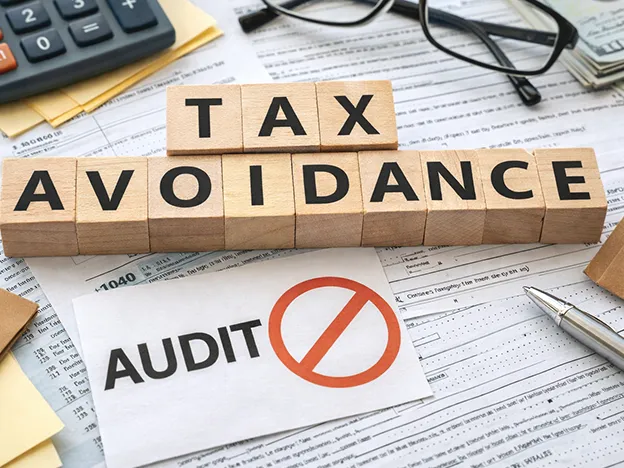
Tax avoidance is the practice of using all available legal methods to reduce the amount of tax you owe.
It involves operating within the tax rules.
This is sometimes done by ‘bending the rules’ to gain a tax advantage that Parliament never intended.
A tax avoidance arrangement might have no genuine purpose other than to save tax.
Such schemes do not violate the letter of the law, but they are often said to go against the spirit of the law.
However, not all tax avoidance is controversial.
Making use of legitimate allowances and reliefs is considered sensible tax planning.
HM Revenue & Customs (HMRC) generally permits responsible tax avoidance (also known as tax planning).
However, HMRC actively discourages aggressive tax avoidance schemes that are set up purely to dodge tax.
The government has introduced special anti-avoidance rules to crack down on schemes that seek to exploit loopholes.
Examples of Tax Avoidance

There are many forms of legal tax avoidance, ranging from everyday tax planning to more complex arrangements.
Here are some common examples:
Using Tax-efficient Savings and Investments
Putting money into an Individual Savings Account (ISA) means any interest or gains are tax-free.
Likewise, paying into a pension (such as a SIPP) reduces your taxable income because these contributions receive tax relief.
Claiming Allowable Expenses and Reliefs
Sole traders and companies can deduct genuine business expenses (office costs, travel, equipment, etc.) from their income, which lowers their taxable profit.
Businesses can also use reliefs like capital allowances or R&D tax credits to legally reduce their tax bill.
Taking Director’s Loans
Company directors may borrow money from their own company as a loan, this is known as a directors loan.
This is legal, but if the loan is never repaid and gets written off, the director has effectively taken tax-free income.
This is a tactic regarded as tax avoidance if done to sidestep taxes.
Disguised Employment
Instead of hiring someone as a regular employee, a company might engage them as a contractor who is paid through their own limited company.
This way, the individual can pay less Income Tax and National Insurance, and the company avoids certain contributions.
HMRC may challenge this practice under IR35 rules if the person is essentially working as an employee in all but name.
Using Offshore Tax Havens
Some people or businesses place assets or income in countries with very low tax rates.
Structuring affairs overseas can legally reduce the tax due, since only the low foreign taxes might be paid.
However, strict rules apply, as merely hiding money offshore without declaring it to HMRC would be evasion, not avoidance.
Tax Avoidance Penalties
While tax avoidance itself is not illegal, it is not without risk.
If you partake in a scheme that HMRC later deems unacceptable, you could end up owing all the tax you tried to save, plus interest on those amounts and an extra penalty charge.
A tax avoidance plan can backfire financially.
The government has even implemented a Serial Tax Avoidance Regime (since the Finance Act 2016) to impose escalating penalties on people who repeatedly use avoidance schemes.
HMRC can also issue Accelerated Payment Notices, requiring users of suspected avoidance schemes to pay the disputed tax up front while the scheme is investigated.
It's worth noting that aggressive tax avoidance can tarnish one’s reputation.
HMRC may flag serial avoiders as ‘high-risk’ taxpayers, meaning their tax affairs get extra scrutiny in future, such as with an HMRC Compliance Check.
Most importantly, if an avoidance arrangement crosses the line into deliberate deception, it ceases to be avoidance and becomes tax evasion.
In such cases, criminal charges can follow.
What is Tax Evasion?
Tax evasion is the outright illegal avoidance of tax.
It typically involves deliberately hiding income, falsifying information, or otherwise cheating the tax system so that less tax is paid than is lawfully due.
In the UK, tax evasion is a criminal offence, and is a form of fraud against the public revenue.
It always entails breaking the law or lying to HMRC.
This could be done by an individual or by a business, and it usually requires willful intent.
Tax evasion can range from small-scale instances (for example, a tradesperson not declaring cash-in-hand jobs) to large-scale fraud (such as concealing millions in offshore accounts).
HMRC estimates that tax evasion costs the UK around £5.5 billion in lost revenues each year.
Because it is deliberate and unlawful, tax evasion is treated very seriously by the authorities.
Examples of Tax Evasion

Tax evasion can take many forms, all of which involve not paying the tax that is due by law.
Common examples include:
Under-reporting Income
A person or business might intentionally declare less income or profits than actually earned, so that HMRC will calculate a smaller tax bill.
‘Off the Books’ Cash Payments
An employer might pay workers in cash without recording it, or a freelancer might request cash payment and not issue receipts.
By keeping these earnings off the books, no Income Tax or National Insurance is paid on them.
Hiding Money or Assets Offshore
Funds can be moved to secret bank accounts or trusts in offshore tax havens and not declared to HMRC.
The aim is to keep this wealth out of sight of UK tax authorities so that it escapes taxation.
False Expense Claims
An individual or company may claim personal expenses as business costs.
For example, writing off a holiday or a personal luxury purchase as a ‘business expense.
Failing to File Tax Returns
Completely neglecting to register for a required tax or not filing a tax return is also evasion if done to avoid paying tax.
By not reporting your earnings at all, you prevent HMRC from assessing and collecting the tax you owe.
Tax Evasion Penalties
Tax evasion carries harsh penalties under UK law.
The exact punishment will depend on the nature and scale of the offence.
For less serious cases, the matter might be tried in a Magistrates’ Court.
If found guilty, the offender can be fined up to £5,000 or even sent to jail for up to 6 months.
More serious cases of evasion are prosecuted in the Crown Court, where sentences can be much heavier, with up to 7 years’ imprisonment and unlimited fines for the most severe offences.
Also, the evaded tax must be paid back to HMRC, along with interest on the unpaid amount.
Aside from court sentences, HMRC also has a policy of ‘naming and shaming’ serious tax evaders.
If someone deliberately evades over £25,000 in tax, HMRC may publish their name and details, which can severely damage their personal or business reputation.
The government has also signalled its intent to toughen penalties even more.
It announced plans to increase the maximum prison term for serious tax fraud from 7 years to 14 years.
All of this underlines that tax evasion is a high-risk crime with very serious consequences.
The Difference Between Tax Avoidance vs Tax Evasion
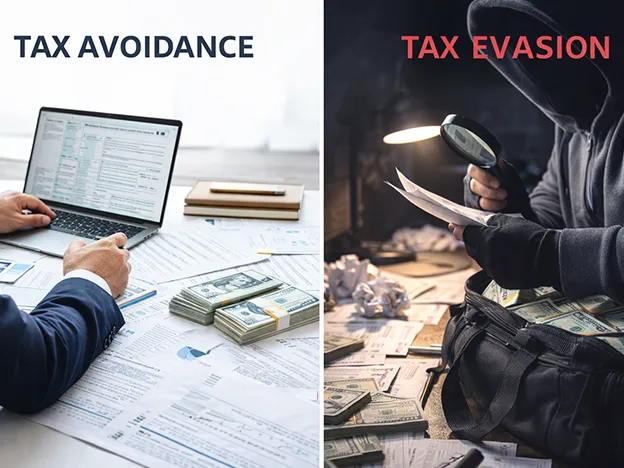
The fundamental difference between tax avoidance and tax evasion comes down to legality and intent.
Tax avoidance is legal.
It involves complying with tax laws (or exploiting grey areas) to minimise the tax you pay.
Tax evasion is illegal.
It involves defying or dodging the law to not pay tax you owe.
Tax avoidance stays within the boundaries of the law, whereas tax evasion crosses the line into unlawful conduct.
Another way to distinguish them is by the methods used.
Avoidance uses loopholes and clever accounting to ‘game’ the system, while evasion uses outright deception or concealment of facts.
There can be a fine line between the two in certain cases.
If a tax avoidance scheme becomes overly aggressive or artificial, it might be reclassified as evasion.
Indeed, HMRC has in the past shut down some avoidance schemes after determining that they were essentially schemes to evade tax.
From a public finance perspective, tax evasion also causes a larger loss to the Treasury.
The consequences also diverge.
Someone practicing legal avoidance might simply have to pay back taxes (and interest) if HMRC finds their scheme doesn’t work, whereas someone committing evasion faces criminal investigation, fines, or even prison.
For individuals and small business owners, the takeaway is that you should always aim to save tax within the law.
Make use of allowances and legitimate tax planning, but steer clear of anything that feels dishonest or too good to be true.
When in doubt, consult a professional.
A qualified accountant, such as us here at One And Only Accounts, can advise you on how to maximise your tax savings in legal ways and ensure you remain compliant
Final Thoughts
You should now have more of an understanding of tax avoidance vs tax evasion.
Tax avoidance and tax evasion may sound like similar concepts, but in practice they are worlds apart.
One is about playing by the rules to reduce your tax bill, and the other is about breaking the rules and risking serious punishment.
Every UK taxpayer has the right to arrange their affairs to pay no more tax than required, but nobody has the right to evade tax unlawfully.
By understanding the difference, individuals and small businesses can engage in smart tax planning without crossing into illegal territory.
No amount of saved tax is worth the risk of committing tax evasion.
It’s always safer and wiser to stick to legal methods of tax avoidance and ensure you sleep easy at night, knowing you’ve met your obligations.
If you’re ever unsure where the line is, seek advice from a tax professional to stay on the safe side
Disclaimer: Any advice in this publication is not intended or written by One and Only Accounts to be used by a client or entity for the purpose of (i) avoiding penalties that may be imposed on any taxpayer or (ii) promoting, marketing or recommending to another party matters herein.